Chelsea And The Impossibility Of Change, By Mara L.

I rarely write about architecture on Notes From Nowhere, even though this is what I’m trained to do – not, of course, to write about it, but to plan it, design it, and so on. I guess I’m like Jens, I find the gap between the world of creating something and the world of criticism rather wide.

Anyway, I read an artnet-article this morning (“Three Dealers” by Charlie Finch, here, via here) that I didn’t quite like, even though much of what it says seems true. It’s about the collapsing art gallery scene in Chelsea. The market is down, we all know that. But the author argues that, worse than that, the High Line, Manhattan’s new elevated park on the West Side, will bring hordes of tourists to Chelsea and thus destroy the serenity of the place. It’s the beginning of the next Soho as we know it today, with tourists everywhere, retail outlets all over, high school kids on their trip to New York getting drunk at night. And so on. We who look for quiet places where the contemplation of art is psychologically and economically possible are out.
Copyright 2009 Jens Haas - www.jenshaas.com

That may all be true, but it’s only part of the truth. And more than anything, it reminds me of my favorite Monk quote. His psychotherapist says, “I know, change is difficult.” And Monk replies: “No, change is impossible.”

Of course the High Line will bring developers and tourists, and of course it will change the face of Chelsea. But here’s a thought: Doesn’t the art world have to reinvent itself every couple of years regardless, or otherwise it will become stale? Shouldn’t we feel, next to the pains of financial worries, the pleasures of curiosity, adventure and excitement when we ask ourselves “what’s next?” And, most of all, shouldn’t we (artists, gallery owners, and critics) also be engaged citizens, who support the first baby steps of Manhattan toward a greener way of life? Developers start to put plants on our rooftops to help lower the temperature in big cities, insulate houses to reduce the energy footprint and improve the quality of the air, and so on. Most of this is still in the future. But the High Line is part of a new way of thinking. People come to recognize that life in cities shall have to change if we don’t want people and the planet to get more and more affected by ailments of all kinds.

As an architect, I see myself as part of a group of younger people who think about conservation, recycled materials, and so on, and I’m quite certain that this is where my field will have to be most innovative in the next couple of years. I don’t quite like the idea that my fellow-artists, those from the ‘fine arts,’ are not on board here.

For a more humane approach to the High Line, see this entry on Diane Pernet’s blog. And let me submit this: Some of us are just normal people who don’t have houses at the beach, but would like to sit in the sun once in a while…
In Other News

Copyright 2009 Jens Haas - www.jenshaas.com

You just cannot appreciate the beauty of a Palin/Cheney ticket for 2012 without taking a close look at some of the regrettable frictions within the Bush/Cheney White House. Time.com’s Massimo Calabresi and Michael Weisskopf close this gap in “Inside Bush and Cheney’s Final Days” (here). My two favorite, admittedly flashy quotes from it, on Vice President Cheney: “…a sounding board for advice he originated himself,” and on White House counsel and Cheney antagonist Fred Fielding: “Freddy isn’t afraid of anyone. He will slit your throat with a razor blade while yawning…” should not detract from the fact that this is an extremely well written piece. Just right for a casual Friday. Enjoy.

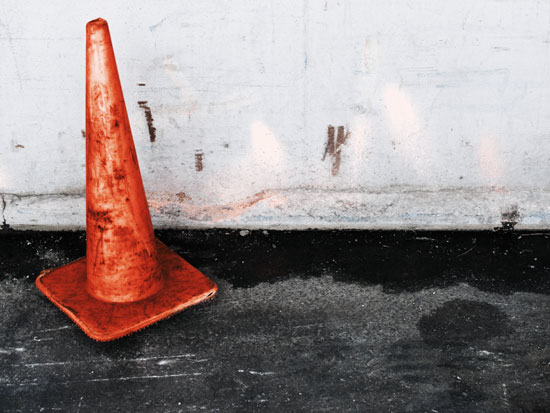
Another Day, Another Traffic Cone 22

Copyright 2009 Jens Haas - www.jenshaas.com

Yesterday I watched Michelangelo Antonioni’s L’Eclisse. As my co-viewer nicely put it, an “intensely pointless, intense and pointless, pointlessly intense (and so on)” movie. Indeed, in a conversation with Mark Rothko, Antonioni once described his movies as empty but precise. So maybe my co-viewer wasn’t too far off. Great photography though, especially towards the end. Certainly precise, and more than that.

The spoken commentary by a film studies professor had us cringe––a reasonably healthy reaction I think to intellectual analysis of intellectual movies about non-intellectual things. Somehow, this kind of “art critic” always manages not to talk about the art but about himself, and drone on forever. Vittoria, the female protagonist, is “unconnected” to the world. The world is “changing.” La borsa is “scientific” (eh?). Vittoria is, in case you missed it, unconnected, and, when she makes a phone call, in the words of the professor this undoubtedly “does kind of represent an attempt to kind of reach out, to kind of establish a connection…” Oh well. Nothing about the photography, the framing, the architecture, the old versus new art in the movie, or indeed anything that the artist might find interesting. But a lot about unconnectedness.

Which reminds me of my other readings this summer. So far: “Anarchy, State, And Utopia” by Robert Nozick (smart and entertaining, however, not all anarchists are convinced), a couple of papers on scepticism (don’t ask), Somerset-Maugham’s “The Razor’s Edge” (a self-assigned service task of the publisher, for one of the aspiring novelists to your right), “The Shining” (I found the first 200 pages a surprisingly good psychological profile of the main characters; instead of reading the remaining 500 pages, I’d rather watch the movie though), “Tales Of Ordinary Madness” by you know who, and a couple of other books I already forgot.

The highlight of the summer, so far, are re-runs of Kojak. The “when men were real men”-awkwardness aside, I cannot get over the fact how ugly today’s cars are in comparison, and how many of them congest this great city.

Put all of this together, and you have the reason why, in my work, I focus on traffic cones.